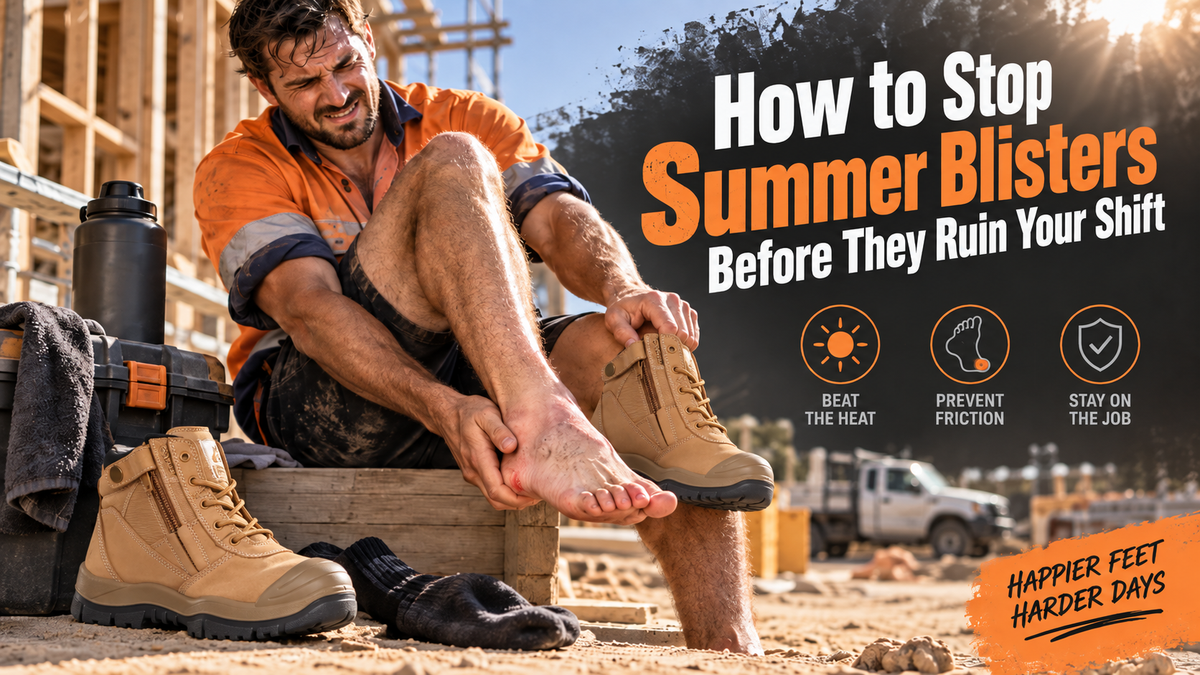
A small hot spot at 9 am can feel like you're walking on sandpaper by knock-off.
Blisters are particularly frustrating for tradies because you can't simply stop walking for the rest of the day. There are ladders to climb, materials to move, concrete to cross and another few thousand steps before the shift is finished.
Summer can make the problem worse. Heat and sweat create moisture inside your safety footwear, while hours of repeated movement create friction. Add boots that don't fit properly and you've got the perfect conditions for rubbing.
The good news? You don't have to accept blisters as part of breaking in a new pair.
Why Do Work Boots Cause Blisters?
Blisters commonly develop when repeated friction causes layers of skin to rub against each other. Moisture and heat can make the situation worse, which is why long summer shifts can be particularly challenging.
When it comes to safety boots, several factors can contribute:
- Boots that are too tight
- Excessive heel movement
- Damp or sweaty socks
- Stiff new footwear
- Incorrect sock thickness
- Pressure around seams or the safety toe cap
- Walking or standing for extended periods
The solution isn't necessarily buying softer footwear. Start by finding out exactly where and why your foot is rubbing.
1. Get the Fit Right Before You Leave the Shop
A common mistake is assuming painful boots simply need to be "worn in".
Some leather footwear will soften and adapt with use, but a fundamentally poor fit isn't something you should expect your feet to fix.
Your toes need enough room to move without repeatedly hitting the steel or composite toe cap. At the same time, your heel shouldn't be lifting excessively every time you take a step.
Pay particular attention to:
- Heel movement
- Toe clearance
- Pressure across the widest part of your foot
- Rubbing around the ankle
- Pressure from seams or internal components
2. Remember Your Feet Can Feel Different by Knock-Off
The fit you experience before work isn't necessarily the fit you'll experience eight hours later.
After spending hours standing and walking, feet can become temporarily fuller. That's one reason a pair that feels snug first thing in the morning may become noticeably tighter later in the shift.
If possible, try new work boots later in the day and wear the type of socks you normally use at work.
Don't deliberately buy oversized footwear to compensate. Too much space can allow your foot to move around inside the boot, creating more friction rather than less.
3. Sweat Management Matters More Than You Think
During summer, moisture can build quickly inside enclosed safety footwear.
Wet skin is more vulnerable to friction, which means sweaty socks and repeated movement can become a painful combination.
When comparing summer work boots, look for designs with breathable or moisture-managing linings and removable footbeds where available.
After work, open the boots properly and allow them to dry before your next shift.
4. Your Socks Could Be Part of the Problem
Don't spend hundreds of dollars choosing the right safety boots and then ignore what's between your foot and the boot.
Work socks affect moisture management, cushioning and friction.
For hot conditions, consider socks designed to move moisture away from the skin rather than holding it there. Make sure they're the right thickness for your footwear too.
A sock that's significantly thicker than the one you wore when fitting your boots can change how much space your foot has inside them.
A Simple Summer Trick
Keep a spare pair of clean work socks in your ute, locker or bag.
If the pair you're wearing becomes soaked during a particularly hot shift, changing into dry socks at lunch can reduce the amount of time your feet spend sitting in moisture.
5. Don't Ignore a Hot Spot
You know that slightly warm, irritated patch on your heel that appears before the blister?
That's the warning.
If you're able to safely stop, deal with the source of friction early rather than waiting until the skin becomes damaged. Check whether your sock has bunched up, your laces need adjusting or debris has entered the boot.
Protective blister dressings can also be useful for areas that are already prone to rubbing. Follow the product instructions and seek appropriate medical advice for significant or infected blisters.
6. Lace Your Boots Properly
Laces aren't just there to keep your boots attached to your feet.
Correct adjustment can help hold the heel securely and reduce unnecessary movement inside the footwear.
If you wear lace-and-zip safety boots, don't simply leave the laces extremely loose because you're using the side zip every day. Establish the correct fit with the laces first, then use the zip for convenient entry and removal where the design allows.
7. Consider Lightweight Safety Boots for Summer
If your job involves constant walking, boot weight is another factor worth considering.
Modern lightweight safety footwear can provide workplace protection without the bulk associated with some traditional designs.
Composite toe safety boots are particularly worth comparing. Composite caps are non-metallic and can contribute to a lighter overall design, although the total weight will vary between models.
Compare safety boots at Work Boots Direct and look closely at construction, fastening, fit and safety features rather than choosing by appearance alone.
8. Break New Boots In Before a Massive Shift
Monday morning before a ten-hour shift isn't the ideal time to discover how a brand-new pair behaves on your feet.
Where practical, introduce new footwear gradually before relying on it for your longest working days.
Wear the boots for shorter periods and pay attention to where you feel pressure or movement. This gives you an opportunity to identify potential trouble spots before you're halfway across a job site with seven hours still to go.
9. Rotate Your Work Boots If You Can
Wearing the same damp pair every day gives the interior less time to dry.
For workers dealing with particularly hot or sweaty conditions, rotating between two suitable pairs can allow each one more drying time between shifts.
It's not essential for everyone, but it can be useful for workers regularly dealing with moisture inside their footwear.
10. Know When the Boot Is the Problem
Sometimes the answer isn't another sock, different lacing or another week of breaking them in.
If the same pair repeatedly causes rubbing, painful pressure or blisters in the same areas, the shape or size may simply be wrong for your feet.
Different brands and models can have different fits. A popular safety boot isn't automatically the right boot for you.
Summer Work Boot Checklist: What to Look for Before Buying
If blisters have been an issue in the past, check these points before purchasing your next pair:
- Enough room for natural toe movement
- A secure heel with minimal unwanted movement
- No immediate pressure against the safety toe cap
- Breathable or moisture-managing lining
- Appropriate sock thickness
- Adjustable fastening
- Lightweight construction where suitable
- Removable footbed where available
- Safety features appropriate for your workplace
Don't Wait Until the First Blister to Question Your Boots
Your safety footwear has to work for more than the first twenty minutes of the morning.
Think about how the boots will fit when your feet are warm, how well the interior manages moisture and whether your heel stays secure after thousands of steps.
Because when you're working through an Australian summer, the best time to prevent tomorrow's blister is before you clock on.
Shop work boots at Work Boots Direct and compare safety footwear for long, hot days on site.